The Evolution of Lighting as Art: From Functional to Fabulous


“Lighting is not just illumination, it’s the jewellery of the home.” – Lindsey Adelman
Lighting as Art, let me tell you, I never thought I’d become so obsessed with lighting design, but here I am, fifteen years into what started as a simple home renovation project. It’s funny how one vintage chandelier at an estate sale can spark a whole journey into understanding how lighting transcends basic functionality and becoming a professional Lighting Designer.
Back in the day, lighting was pretty much just about being able to see stuff after dark. Think about those bare bulbs hanging from ceilings – totally utilitarian. But nowadays? Lighting fixtures have become legitimate pieces of Lighting as Art that can transform any space
The real game-changer in lighting design happened during the Art Nouveau period (1890-1910). Those gorgeous Tiffany lamps weren’t just about illumination – they were revolutionary pieces that merged function with stunning artistry.
The way those coloured glass pieces filter light still influences modern designs. I’ve spent countless hours studying these historical pieces, and let me tell you, there’s nothing like seeing a genuine Tiffany in person.
One thing that drives me absolutely nuts is when people treat all ambient lighting the same.
Listen up: there’s a massive difference between warm ambient lighting (2700-3000K) and cool ambient lighting (4000K+).
The wrong colour temperature can make your carefully curated space feel like a sterile doctor’s office or an overly cosy cave.
Remember, lighting fixtures aren’t just about brightness levels and practicality anymore.
They can be conversation starters, mood setters, and can literally make or break your interior design.
I’ve seen rooms go from meh to magnificent just by swapping out a basic flush mount for something with actual design intention.
The evolution of lighting continues to amaze me, and I’m stoked to see where it goes next. Just remember – good lighting design is like a well-conducted orchestra. Every piece has its part to play, and when they work together? Pure magic happens. Just the recipe for Lighting as Art.
The Historical Journey: From Candlelight to Electric Marvels
You know what’s wild? Before the 1800s, people literally had to plan their entire lives around natural daylight. I’ve tried living by candlelight for a weekend (yes, I’m that kind of history nerd), and let me tell you – it gave me a whole new appreciation for modern conveniences!
The average worker in the 1700s would burn through about 3-4 tallow candles per night, which would cost them nearly a day’s wages. Can you imagine spending that much just to see after dark?
The real game-changer came with whale oil lamps in the late 1700s. These babies burned way brighter than candles, but holy smokes, they STANK. Like, clear-the-room levels of stink.
The history books don’t usually mention that part! But people put up with it because having better light was worth smelling like a fishmonger’s dock.
One of my favourite periods to study is the gas lighting era (1820s-1900s). Those beautiful gas fixtures you see in historic homes weren’t just for show – they were cutting-edge technology!
Though I got to tell you, after reading accident reports from that period, I’m pretty glad we moved on to safer options. Those gas lines could be seriously sketchy.
Here’s something that blows my students’ minds: Thomas Edison didn’t actually invent the first electric light bulb (shocker, right?).
Several inventors had already created working versions, but Edison’s genius was in developing a PRACTICAL bulb that could last longer than a few hours.
His carbon filament bulb from 1879 could burn for around 40 hours – pretty weak sauce compared to modern LEDs, but revolutionary for its time.
Want some mind-blowing statistics about lighting evolution? Check these out:
– A modern LED bulb is about 100 times more efficient than Edison’s first bulb
– Early electric street lights were so bright (arc lamps) that they could cause eye damage
– The average American home in 1900 used about 4 lightbulbs total
– Today’s homes average 40+ light sources
The Birth of Lighting Design as a Discipline becoming Lighting as Art.
You know, it’s pretty wild how lighting design evolved from being just “who’s gonna put up the chandelier” to a full-blown professional field. it’s way more fascinating than most people realize.
Back in the early 1900s, nobody really thought about lighting as its own thing – it was just part of electrical engineering or architecture. But then theatre changed everything.
I love telling about Stanley McCandless, who basically became the godfather of lighting design in the 1920s. This guy was teaching at Yale when he realized, “Hey, maybe we should actually think about how we use light to create specific effects?” Mind-blowing stuff for that time!
The really cool part? McCandless came up with this systematic approach to stage lighting that we still use today.
He broke everything down into areas and purposes – kind of like creating a recipe for light just like artwork has layers so can lighting as art.
Here’s what’s super interesting about the birth of architectural lighting design: it literally grew out of Broadway!
Theatre lighting designers started getting called in to work on buildings because they understood something that engineers didn’t – light isn’t just about brightness, it’s about creating emotions and experiences.
Want to know the key principles that emerged during this period? These are still golden rules:
– Form following function (but make it beautiful)
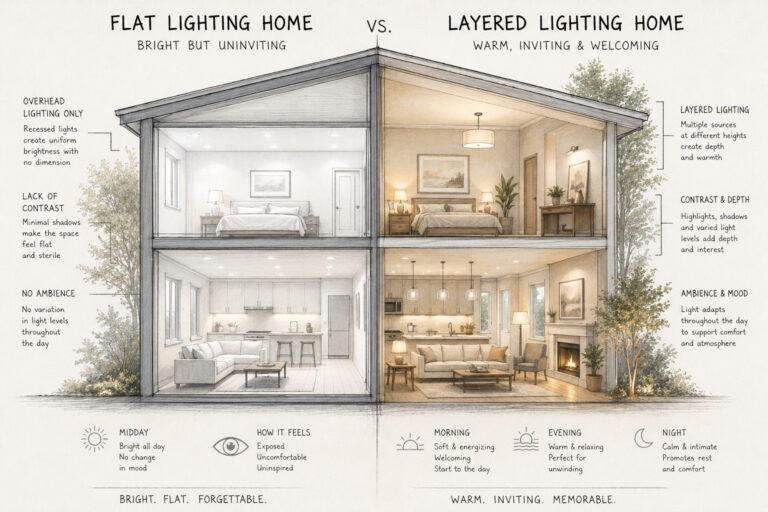
– Layered lighting for different purposes
– Understanding shadow as much as light
– Colour temperature and its psychological effects
– Integration with architecture using lighting as art.
You know what’s fascinating? The way lighting design has had to evolve with new technology. When LEDs first hit the scene, a lot of old-school designers resisted them hard. But now?
The most important thing I’ve learned from studying the history of lighting design is that good lighting should be felt, not seen.
That’s what those early pioneers figured out – when lighting design is done right, people don’t notice the lighting itself, when it is Lighting as Art, they just feel more comfortable, more productive, or more inspired in the space.
Mid-Century Modern: A Golden Age for Artistic Lighting
The Mid-Century era is filled with Iconic designers and their contributions.
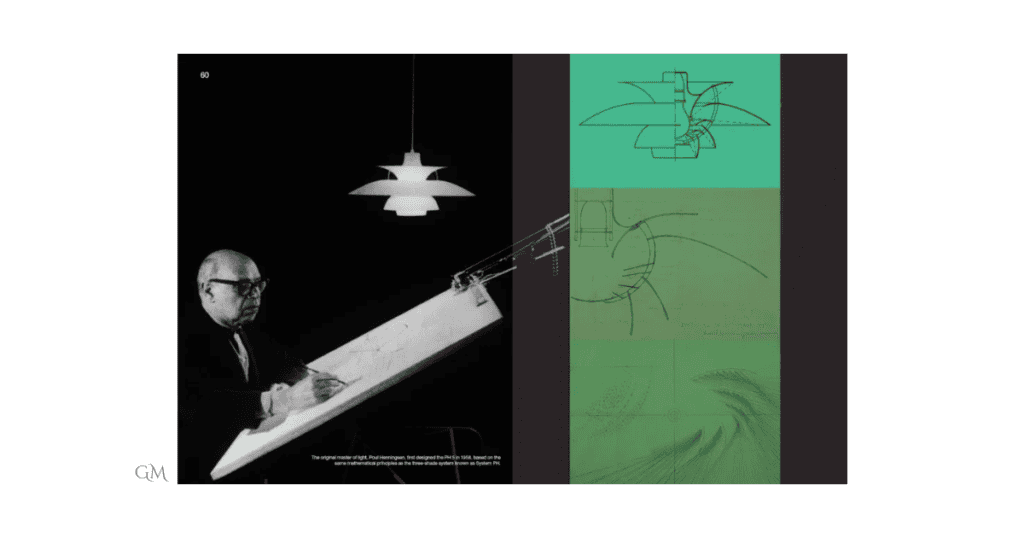
The first time I saw a Poul Henningsen PH5 pendant in person, I literally gasped. No joke! The way this Danish genius figured out how to layer those shades to eliminate glare while creating this perfect, warm glow – it’s pure mathematics meets poetry.
I spent months trying to understand how he calculated those precise angles. And get this: he actually developed his first designs in 1925 because his mom complained about the harsh light from electric bulbs. Talk about solving a real-world problem!
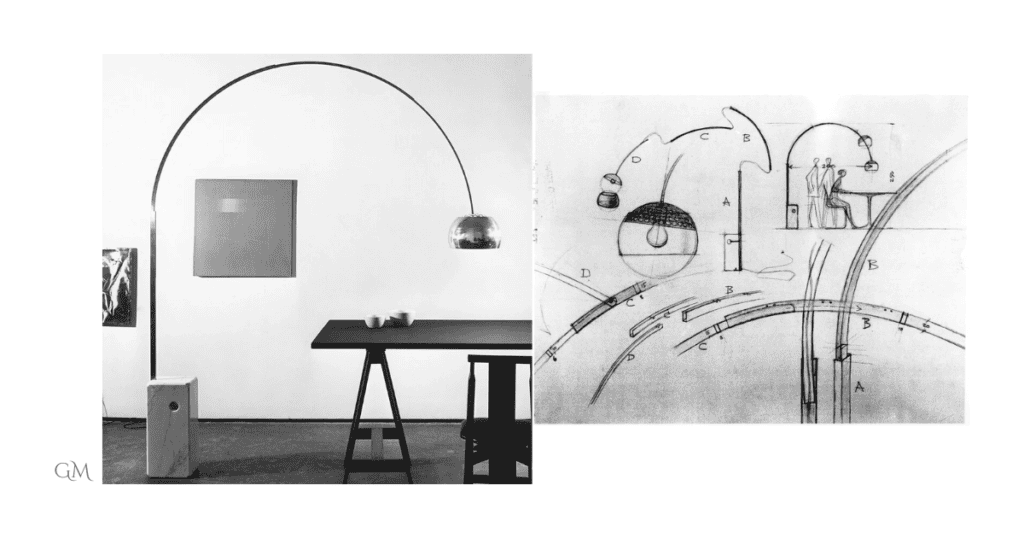
Achille Castiglioni was another absolute maverick of this era. His Arco floor lamp from 1962? Total game-changer. The way he took this crazy idea of hanging a street lamp from a marble base and turned it into the most iconic floor lamp ever… brilliant! I remember trying to move one during a home renovation – that marble base weighs like 65 pounds! But that’s what made it stable enough to stretch out over a dining table without tipping.
Here’s what made mid-century lighting so revolutionary:
– Focus on form AND function (no more choosing between pretty or practical)
– Use of innovative materials like spun aluminium and acrylic
– Perfect balance of industrial and organic shapes
– Emphasis on indirect lighting techniques
– Integration of adjustable elements
Want to know something wild? A lot of these iconic pieces were actually considered pretty radical when they first came out. The Lighting as Art hadn’t quite been embraced yet.
The Nelson Bubble lamps? George Nelson took inspiration from a self-webbing plastic spray used by the U.S. military to mothball ships. Who looks at ship preservation materials and thinks “Hey, that would make a gorgeous lamp shade”? A genius, that’s who!

The influence of mid-century lighting on today’s designs is everywhere once you know what to look for. Those clean lines, the mix of materials, the focus on both diffused and directional light – it’s all rooted in mid-century principles.
I see these elements interpreted in everything from high-end designer pieces to budget-friendly big box store offering
I’ve put original 1950s pieces in ultra-modern spaces, and they look like they were made for each other. That’s the mark of truly timeless design – it transcends its era.
The Pop Art Revolution in Lighting Design
You know what’s wild about the 1960s lighting scene? It completely flipped everything we knew about “proper” lighting design on its head.
After years of studying this era and collecting pieces from this period, I still get excited about how these designers just said “nope!” to all the rules.
The whole Pop Art movement was basically a giant middle finger to traditional design, and lighting wasn’t spared. It was in this era that Lighting as Art was truly explored.
Here’s what made Pop Art lighting so groundbreaking:
– Usage of bold, almost shocking color combinations
– Experimental shapes that defied gravity
– Mass-produced materials used in luxury items
– Playful, sometimes humorous design elements
– Emphasis on youth culture and modernity
You wouldn’t believe some of the materials these designers experimented with.
Joe Colombo created entire lighting collections using ABS plastic and newly developed synthetic materials. It was like they were saying, “If we can put a man on the moon, we can definitely make a lamp out of space-age plastic!”

The best part about Pop Art lighting was how it democratized design.
Before this, “good” lighting was all about expensive materials and traditional craftsmanship. But suddenly, thanks to new manufacturing processes, amazing design was available to everyone. Lighting as Art became visible.
Though trying to explain to people why a plastic lamp cost as much as a crystal one probably gave some retailers grey hair!
One thing that kills me about this period is how many incredible pieces ended up in landfills because people thought they were “cheap.”
I can’t tell you how many times I’ve heard stories about amazing pieces being thrown out during home clean-outs in the ’80s and ’90s. Makes me want to build a time machine just to go back and rescue them!
The influence of Pop Art lighting is everywhere in today’s designs. Those IKEA lamps with the crazy colors and plastic materials? Total Pop Art descendants. Though sometimes I look at modern interpretations and think, “Nice try, but Panton did it better fifty years ago!”
Minimalism and Sculptural Lighting: Less is More – The rise of lighting as art pieces
You know what’s fascinating about minimalist lighting? It’s probably the hardest design style to get right.
After spending years working with these pieces, I can tell you that creating something that’s both simple AND powerful is way trickier than making something complicated.
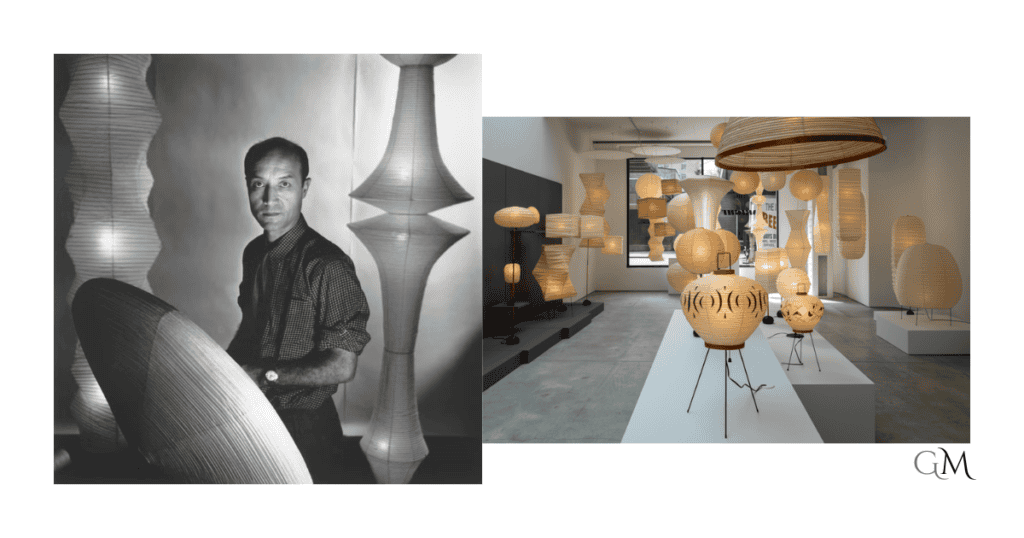
My first encounter with an Isamu Noguchi Akari light sculpture. I was visiting a design museum, turned a corner, and there it was – this perfect paper lantern that somehow managed to look both ancient and futuristic at the same time. It literally stopped me in my tracks. That moment completely changed how I thought about lighting design.
The whole “less is more” philosophy sounds great until you actually try to implement it! I learned this the hard way when I first started working with minimalist fixtures.
Turns out, when you strip away all the extra details, every tiny proportion has to be absolutely perfect.
I once spent three hours adjusting the height of a single pendant light because even a half-inch difference threw off the entire room’s balance.
Here’s what makes minimalist lighting so revolutionary:
– Perfect proportions are absolutely crucial
– Materials must be flawless (there’s nowhere to hide imperfections)
– Every element needs to serve both form and function
– Negative space becomes as important as the fixture itself
– Light quality becomes more noticeable than the fixture
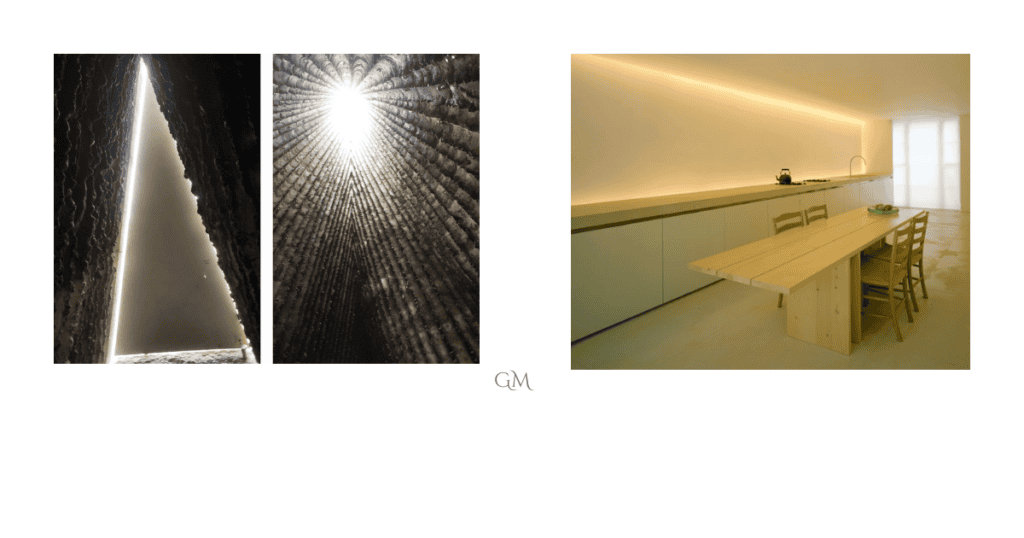
The genius of designers like Peter Zumthor and John Pawson is how they managed to make lighting disappear and stand out simultaneously.
I remember walking through a Pawson-designed space and not seeing a single visible light fixture, yet the illumination was perfect.
That’s when it hit me – true minimalism isn’t about making things plain, it’s about making them precise. Making them Lighting as Art embodied.
Speaking of precision, let’s talk about Michael Anastassiades’ work.
His Mobile Chandeliers look so simple – just black lines and glass globes floating in space. But try hanging one perfectly level! I spent an entire afternoon once adjusting counterweights to get one of his pieces to balance just right.
The client walked in and said, “Oh, it’s just a few lights on sticks?” I nearly cried!

You want to know what really drives me nuts? When people think minimalist lighting means boring lighting.
Nothing could be further from the truth! These pieces are like sculptures that happen to produce light. I’ve seen entire rooms designed around a single Davide Groppi fixture because it had such presence.

The hardest lesson I’ve learned about minimalist lighting is that it demands perfect execution. There’s no hiding messy wiring or uneven spacing behind decorative elements. Truly Lighting as Art and inspiring.
Here’s something wild: some of the most impactful minimalist pieces actually use really complex engineering to achieve their simplicity.
Take Ingo Maurer’s LED wallpaper – it looks like the simplest thing in the world, but the technology behind it is mind-boggling. That’s the real art of minimalism – making incredibly complex things appear effortless.
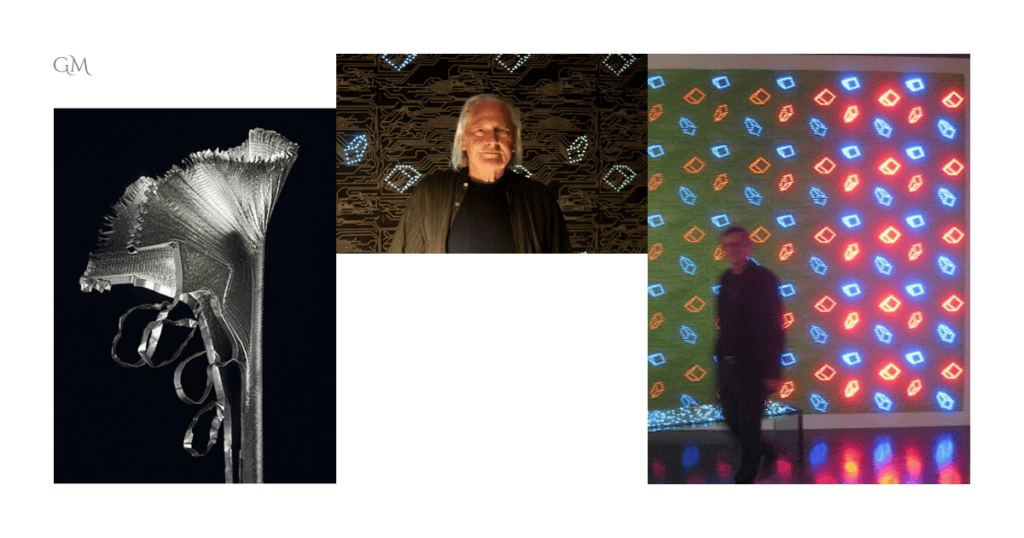
Technology Meets Art: The Digital Age of Lighting, Easy Lighting as Art
– Introduction of LED technology and its impact on design possibilities
– Smart lighting systems and their integration with home decor
– Interactive and responsive lighting installations
I still remember installing my first LED strip lights in my home studio. Man, what a game-changer that was! After spending decades dealing with hot halogen bulbs and limited colour options, LEDs opened up this whole new world of possibilities.
The best part? These things barely sip electricity compared to traditional bulbs. I’ve tracked my energy bills before and after switching, and we’re talking about a 75% reduction in lighting costs. Not too shabby!
Smart lighting systems have totally revolutionized how we think about interior design. Smart lighting makes it easy to create Lighting as Art at the touch of a screen or voice control.
Once you’ve experienced the convenience of voice-controlled lighting scenes, there’s no going back to regular old light switches.
The coolest projects I’ve worked with have got to be responsive lighting installations. Picture this: LED panels that react to movement, creating these gorgeous ripples of light as people walk by.
I installed something similar for a local art gallery, and the way it transformed the space was magical. The key is finding the right balance between interactive elements and ambient lighting.
Lighting as Art can take many forms and as elaborated in the above post has many sources.
Being creative with products and substances is so much more available to all of us now with the availability of 3D printers too, makes it so much easier to be creative in whatever form we wish.
As Art Lighting can be expressive, create a mood or feeling and change how a space looks.
Be creative and don’t be afraid to use Lighting as Art in your home it doesn’t have to cost much either.
When you come to the realization that lighting your home is not just about brightness but how your lighting makes your home feel, it is then that you can truly grasp the concept of Lighting as Art for your Home.