
Modern vs. Traditional Kitchen Island Lighting: Which is Right for You?

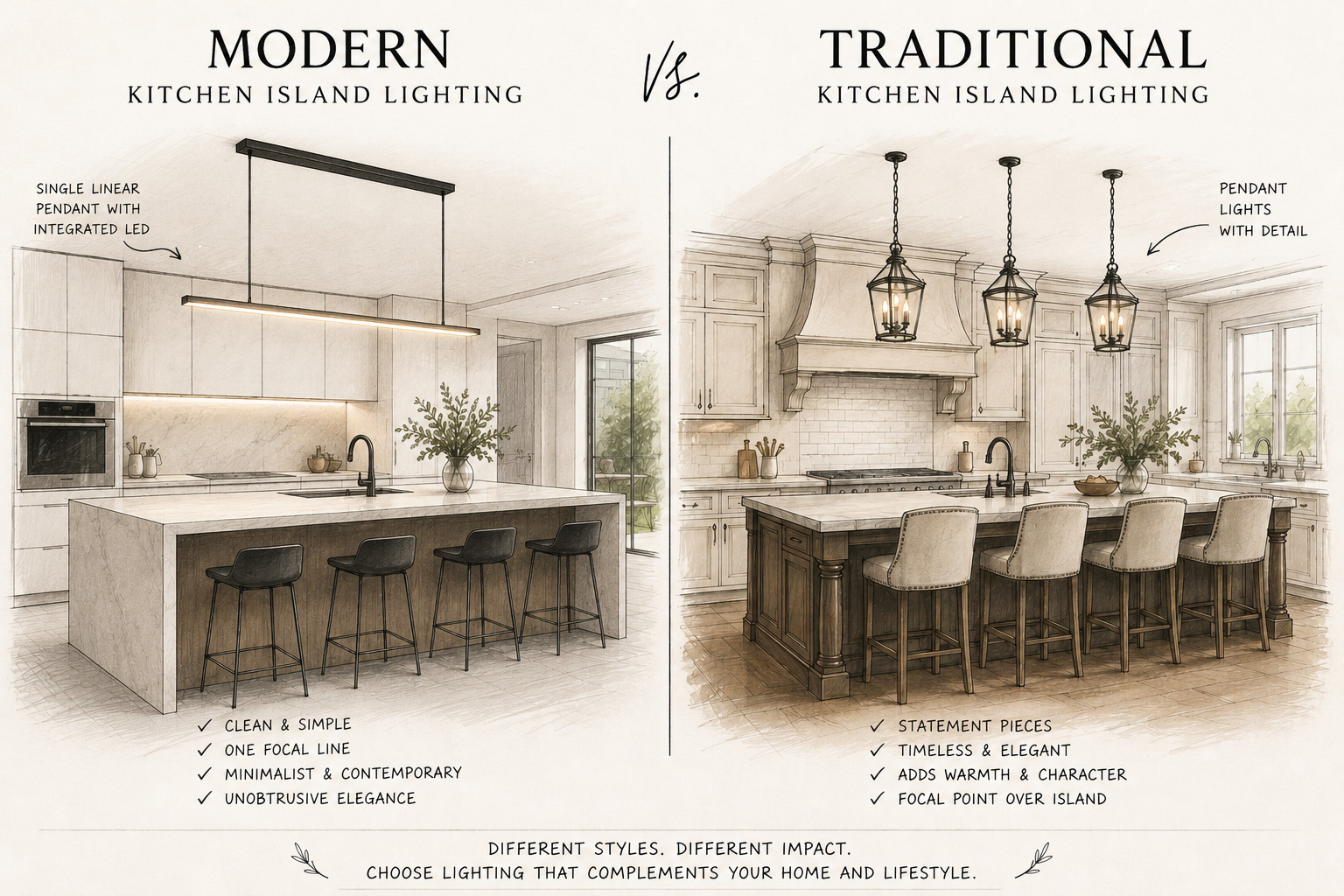
As an interior lighting specialist, let’s look at Modern vs Traditional Kitchen Island Lighting, where I’ve guided countless homeowners through the decisions between sleek modern fixtures and timeless traditional designs.
Want to know what really surprised me? The most successful kitchen designs often thoughtfully blend elements of both! Whether you’re team modern minimalism or traditional elegance, I’ll help you navigate the exciting world of kitchen island lighting to find your perfect match.
Understanding Modern Kitchen Island Lighting
Let me tell you, kitchen island lighting is one of those things nobody thinks about until they’re standing in the dark trying to chop onions at 7 pm. I learned that lesson the hard way.
So what actually makes lighting “modern” or “contemporary”? It’s not just about looking trendy on Pinterest.
Contemporary kitchen design leans hard into clean lines and function-first thinking. Every fixture should earn its spot; there’s no room for clutter or fussy details anymore. I remember helping clients pick fixtures for their remodel and they kept gravitating toward these ornate chandelier-style pendants. We had to have a real talk about how that clashes with her sleek quartz counters and flat-panel cabinets.
Minimalist styles are huge right now, and for good reason. Think single-bulb pendants, slim linear fixtures, and fixtures that almost disappear into the ceiling. Matte black and brushed brass finishes keep popping up everywhere, they add just enough personality without screaming for attention.
Here’s where it gets interesting: LED technology has basically taken over, and honestly it should have happened years ago. LEDs use up to 75% less energy than old incandescent bulbs and last way longer; we’re talking 25,000 hours versus like 1,000 for a regular bulb. That’s not a typo.
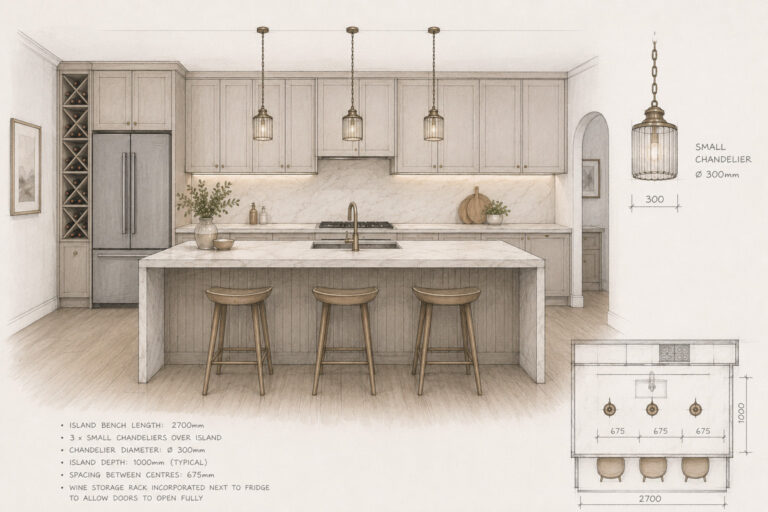
Geometric shapes are everywhere too. Hexagons, asymmetrical clusters, sculptural globe pendants arranged in odd numbers (three seems to be the magic number for some reason). It gives a kitchen that intentional, designed-on-purpose look instead of “we just grabbed whatever was on sale.”
And smart lighting, oh man, this is where things get fun. Being able to dim your lights from your phone or set a “cooking mode” that brightens everything to full task lighting? Total game changer. My only gripe is when the wifi glitches and you’re stuck yelling at Alexa while your pasta water boils over. Not ideal, but still worth it overall.
Traditional Kitchen Island Lighting Elements
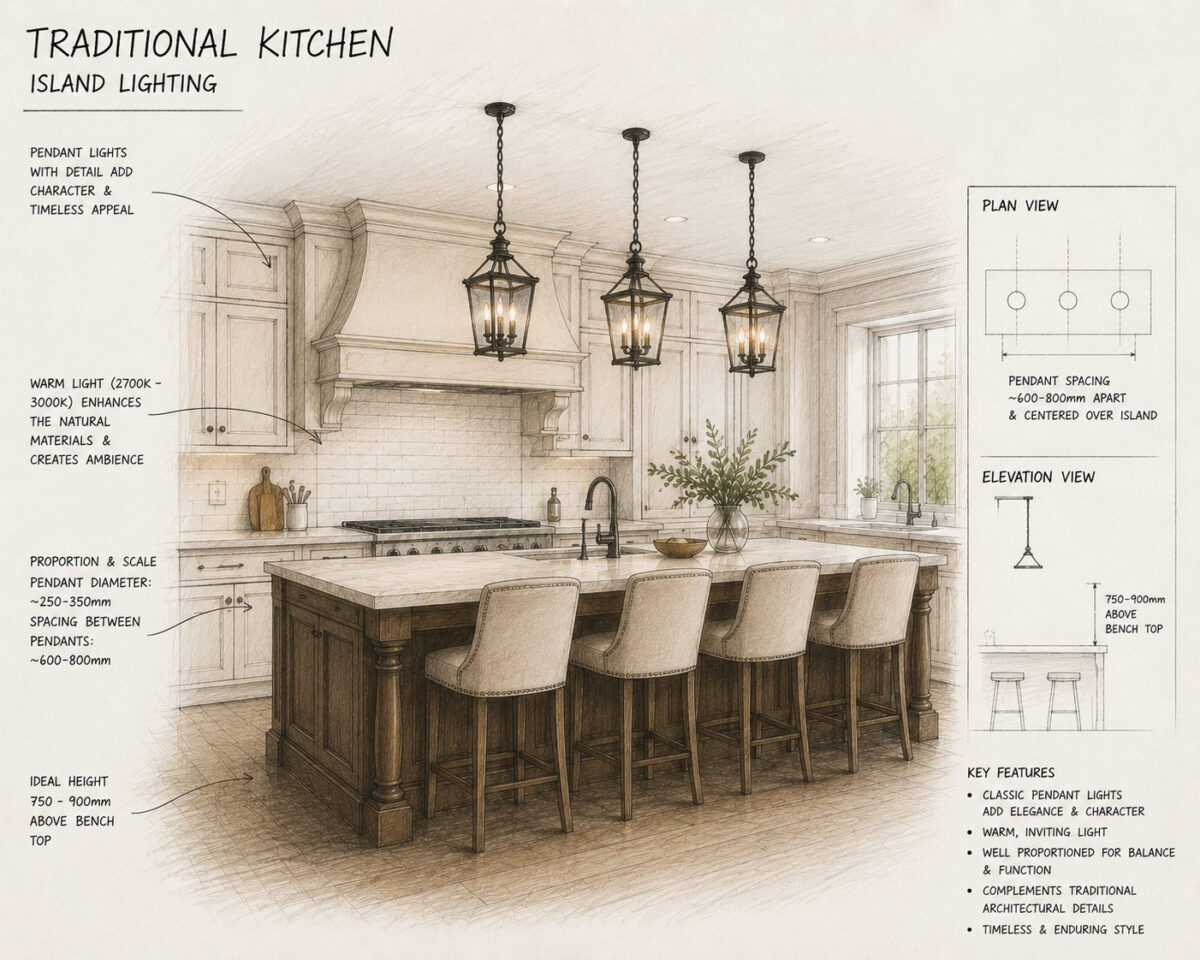
Now let’s swing the other direction, because not everybody wants that sleek modern look. Traditional kitchen island lighting has its own charm, and honestly, it’s not going anywhere anytime soon.
Classic design features tend to focus on ornamentation and craftsmanship. We’re talking scalloped edges, fluted glass shades, and fixtures with actual visible detail work instead of that bare-bones minimalist thing. My grandmother’s kitchen had this brass chandelier with little glass tulip shades, and I swear that thing is more “in style” now than it was twenty years ago. Funny how that works.
Material choices in traditional lighting lean toward stuff that ages well and only gets better looking over time. Aged bronze, oil-rubbed bronze, wrought iron, and antique brass are the big players here. These finishes actually develop a patina, which is just a fancy word for that worn-in look that makes a fixture feel like it’s been there forever, even if you installed it last Tuesday. And these finishes in the retail market are having their spot at the moment, which makes it easy to incorporate these finishes into your traditional style.
Hanging height matters more than people realise, and I’ve messed this up before. For a pendant over an island, the general rule is 600mm to 700mm above the counter surface, measuring from the bottom of the fixture. Too high and it looks lost; too low and someone’s gonna bonk their head reaching for the fruit bowl.
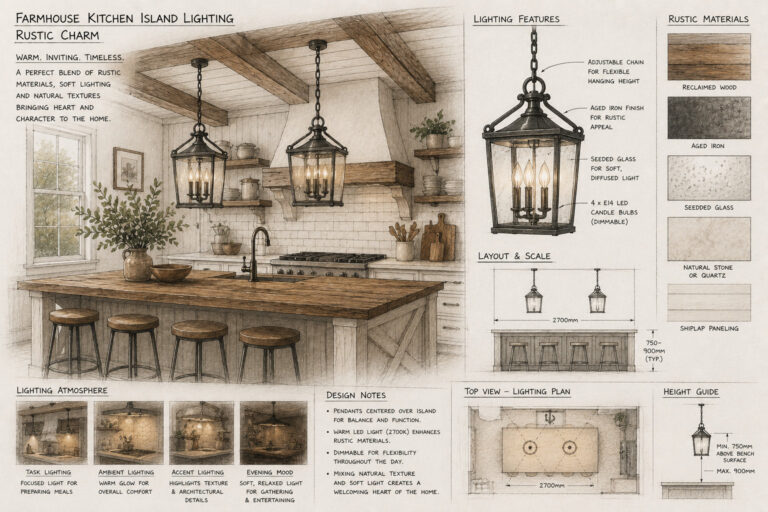
A lot of traditional fixtures pull inspiration from specific eras, think Victorian, colonial, or early 1900s farmhouse style. Lantern-style pendants and candle-style chandeliers are super common, they nod back to a time before electricity when actual candles or oil lamps did the job.
Color schemes tend to stay warm and grounded. Warm whites (soft white bulbs around 2700K to 3000K) pair beautifully with traditional fixtures, they give off that cozy, golden glow instead of the stark blue-white you’d see in a modern setup. Deep woods, creams, and warm metals round out the palette.
It’s a whole different vibe than modern lighting, but it works when done right.
Style Comparison: Modern vs. Traditional for Kitchen Island Lighting
Alright, so how do these two styles actually stack up against each other? I get asked this a lot, usually by people standing in my lighting showroom looking overwhelmed.
Shape-wise, it’s night and day. Modern fixtures favor geometric, sculptural forms, think spheres, cylinders, and asymmetrical arrangements. Traditional fixtures go for curves, scrollwork, and layered details like tiered chandeliers or fixtures with multiple arms branching out. I once tried mixing a super angular modern pendant into a kitchen with ornate crown molding and it just looked wrong, like two different houses got smashed together.
Materials tell a similar story. Modern lighting sticks to matte black, brushed nickel, and even things like smoked glass or exposed bulb filaments for that industrial edge. Traditional leans on aged metals, oil-rubbed bronze, antique brass, and sometimes crystal accents for a little sparkle. Neither is better, it just depends on what your cabinets and countertops are already doing.
Color palettes vary quite a bit too. Modern spaces usually pair with cooler light temperatures, around 3500K to 4000K, giving that crisp, clean look. Traditional kitchens almost always go warmer, that 2700K to 3000K range I mentioned earlier, because it complements wood tones and creates a cozier feel.
Installation is where things get technical, and where I’ve definitely underestimated a project before. Modern fixtures, especially recessed lighting or LED strips, often need more electrical planning upfront, always requiring a licensed electrician for proper wiring and dimmer compatibility. Traditional fixtures, particularly heavier chandeliers, need solid ceiling support; often extra noggins in the ceiling same as for fans.
Now, pricing. This surprises people. Modern LED and smart fixtures can range anywhere from $50 for a basic pendant to $500+ for high-end smart systems with app integration. Traditional fixtures, especially ones with real crystal or hand-forged metal, can actually run higher, sometimes $300 to $1,000 for a statement chandelier. So don’t assume traditional is automatically cheaper, it’s really not always the case.
Bottom line, both styles have real tradeoffs worth thinking through before you buy anything.
Modern Kitchen Island Lighting Trends
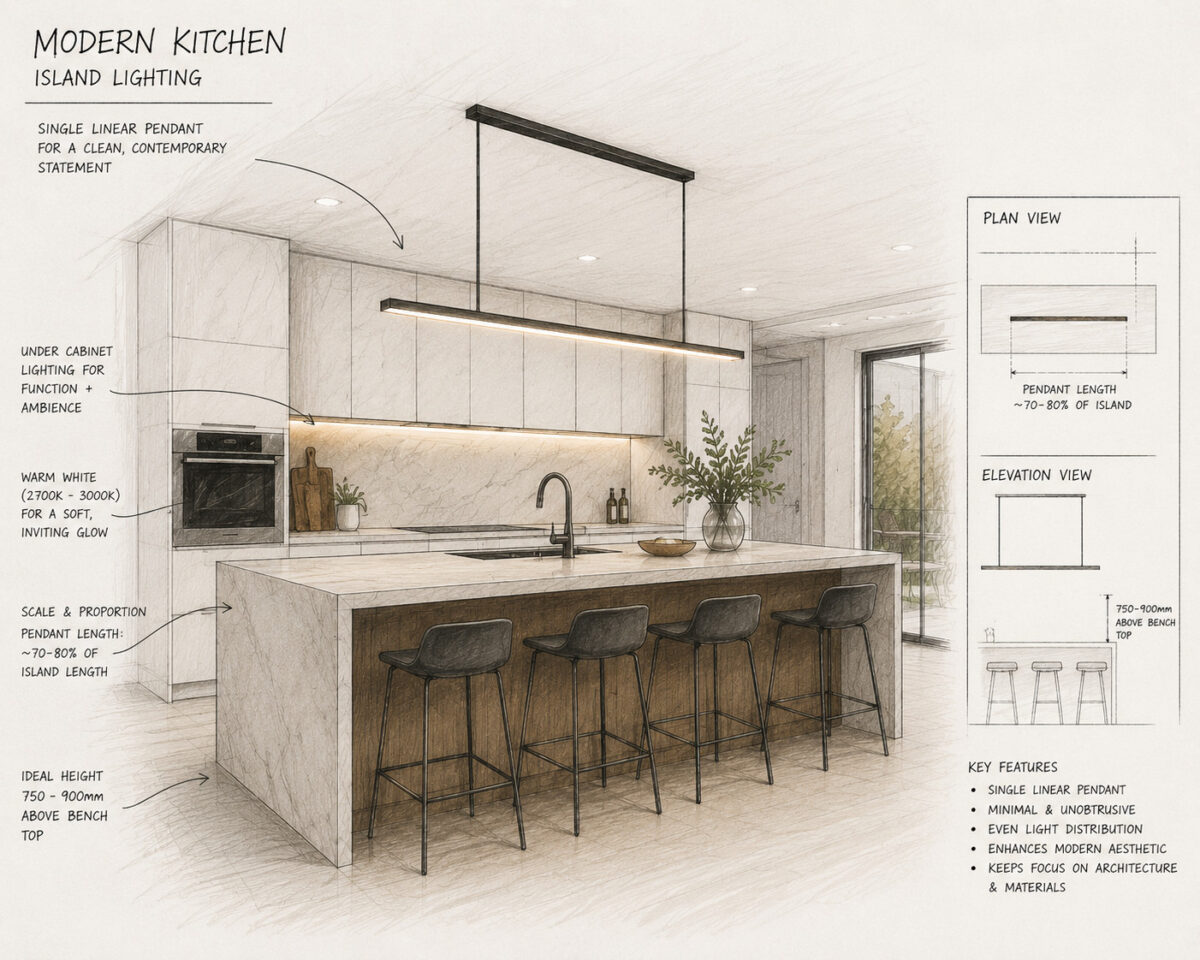
Kitchen islands have basically become the star of the show in most homes now, so it makes sense the lighting above them has gotten way more interesting too. This is honestly my favorite category to talk about.
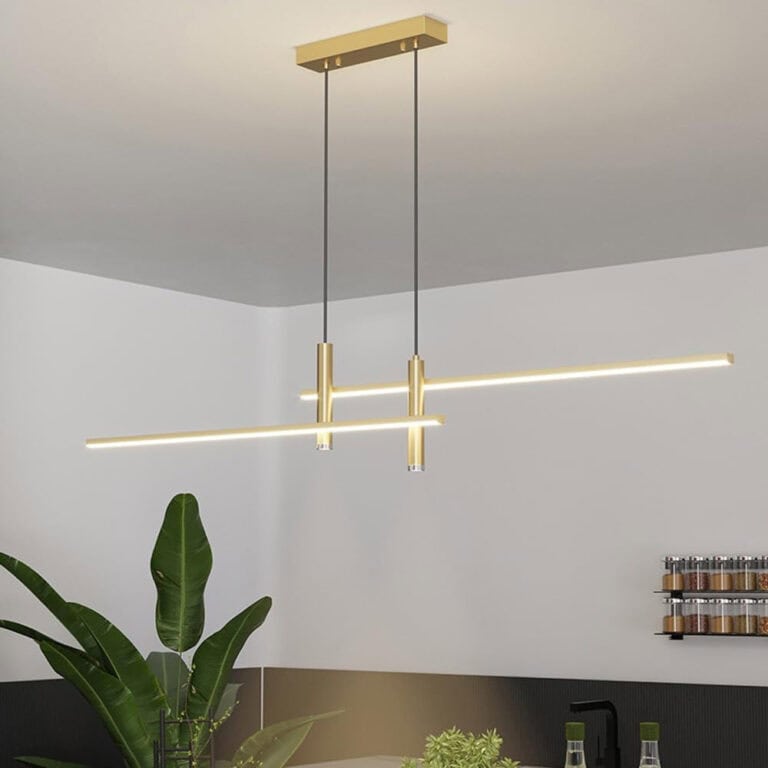
Linear suspension systems are everywhere right now, and I get why. Instead of three separate pendants hanging in a row, you get one long fixture that runs the length of the island, often with individual LED sections built right in. From a practical perspective, you cannot beat the Linear Kitchen Island Lighting; it is continuous and usually has all the lumens needed on your bench too.
Sculptural pendants are having a moment too. We’re talking organic, almost art-piece-looking fixtures, blown glass in weird bubble shapes, or metal cages that cast cool shadow patterns on the ceiling. These aren’t just light sources anymore, they’re basically kitchen jewelry. A little pricey sometimes, but the visual payoff is real.
Mixed metal finishes used to be a design no-no, now it’s kind of the whole point. Pairing matte black fixtures with brass hardware, or brushed nickel with warm gold accents, gives a kitchen some depth instead of that matchy-matchy look from a few years back. Just don’t go overboard, two finishes max is usually the sweet spot, three starts looking chaotic.
Integrated LED solutions are probably the biggest functional shift I’ve seen. Instead of a bulb sitting inside a shade, the LED chip is built directly into the fixture housing. This means slimmer profiles, better energy efficiency (we’re talking 80-90 lumens per watt in a lot of these newer fixtures), and honestly less maintenance since you’re not swapping bulbs every year or two.
Asymmetrical arrangements are the trend that took me longest to warm up to, not gonna lie. Instead of three matching pendants evenly spaced, designers are clustering fixtures at different heights or offsetting them intentionally. It feels random at first glance but it’s actually super deliberate. Once I saw it done right in a kitchen with a long island, I got it immediately, it draws your eye across the whole space instead of just down the middle.
These trends aren’t just about looking cool for Instagram, they genuinely change how a kitchen functions day to day.
Popular Modern Materials and Finishes
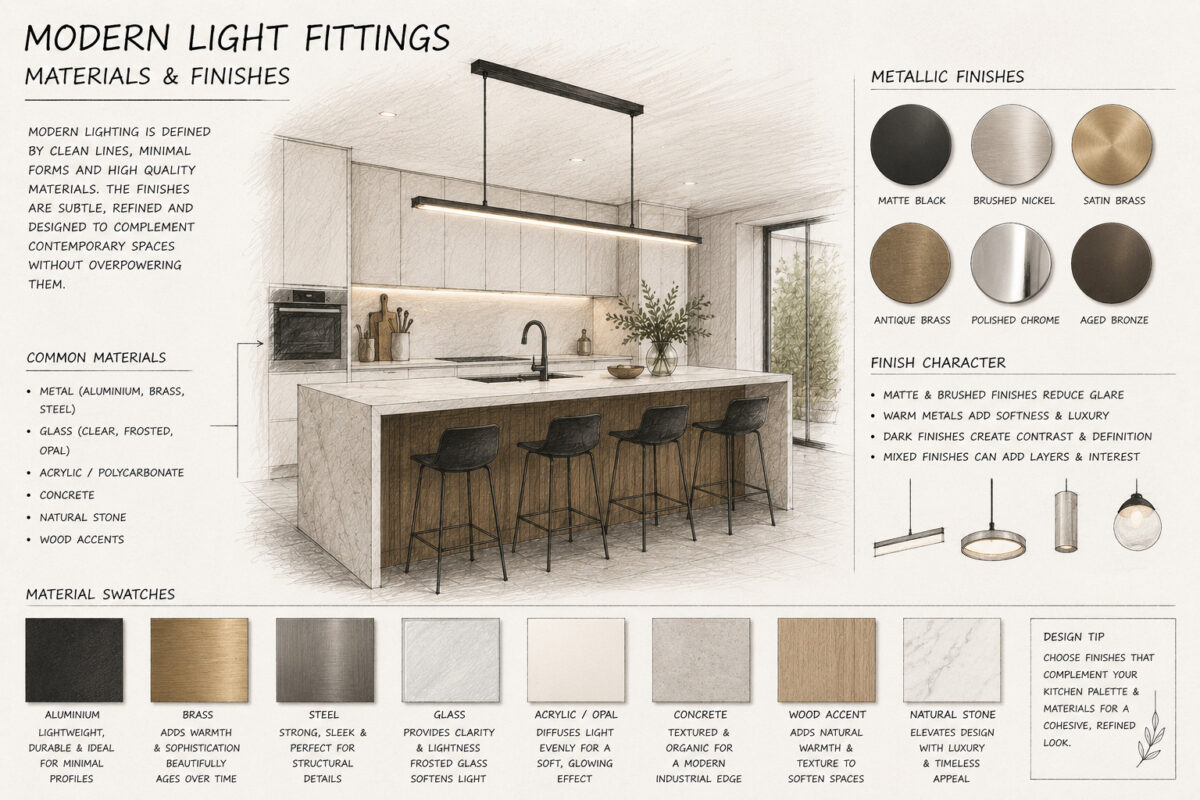
Materials can honestly make or break a modern kitchen island lighting setup. I’ve seen gorgeous fixture designs get totally undercut by the wrong finish, so this part actually matters more than people think.
Brushed aluminum is one of those quiet workhorses in modern design. It’s lightweight, resists fingerprints way better than polished metals, and has this soft, muted sheen that doesn’t scream for attention. I used it in a small galley kitchen once because the space felt too busy for anything shinier, and it toned everything down nicely.
Matte black treatments, though, these are still the reigning champ of modern kitchens. There’s just something about matte black that makes a fixture look intentional instead of like it just got thrown up there. It pairs with basically everything, wood tones, white cabinets, marble counters, you name it. My one warning here is that matte black shows dust and grease spots more than you’d expect, especially near the stove. Wipe it down regular or it starts looking a little sad.
Chrome and steel are making a bit of a comeback too, which surprised me honestly. For a while everyone was scared of anything too shiny, thinking it looked dated or too “early 2000s.” But polished chrome paired with waterfall countertops and glossy cabinets is looking fresh again, especially in high-contrast black and white kitchens.
Glass and acrylic choices add a totally different texture to the mix. Smoked or frosted glass shades diffuse light softer, which is nice over an island where you don’t want harsh glare while you’re eating dinner. Acrylic is more budget-friendly and shows up a lot in globe-style pendants, though I’ll admit it can look a little cheap if the quality isn’t there, so read reviews before buying anything acrylic online.
Then there’s the whole contemporary metal blend trend, mixing two finishes into a single fixture. Think a matte black frame with brushed gold detailing, or steel arms with copper accents. It gives depth without needing multiple separate fixtures to pull it off, and it’s become one of my go-to recommendations for kitchens that feel a little flat or one-note.
Lately, there has been the introduction of stone accents on pendants and lamps that lux up an item without blowing the price.
Sizing and Placement Guidelines
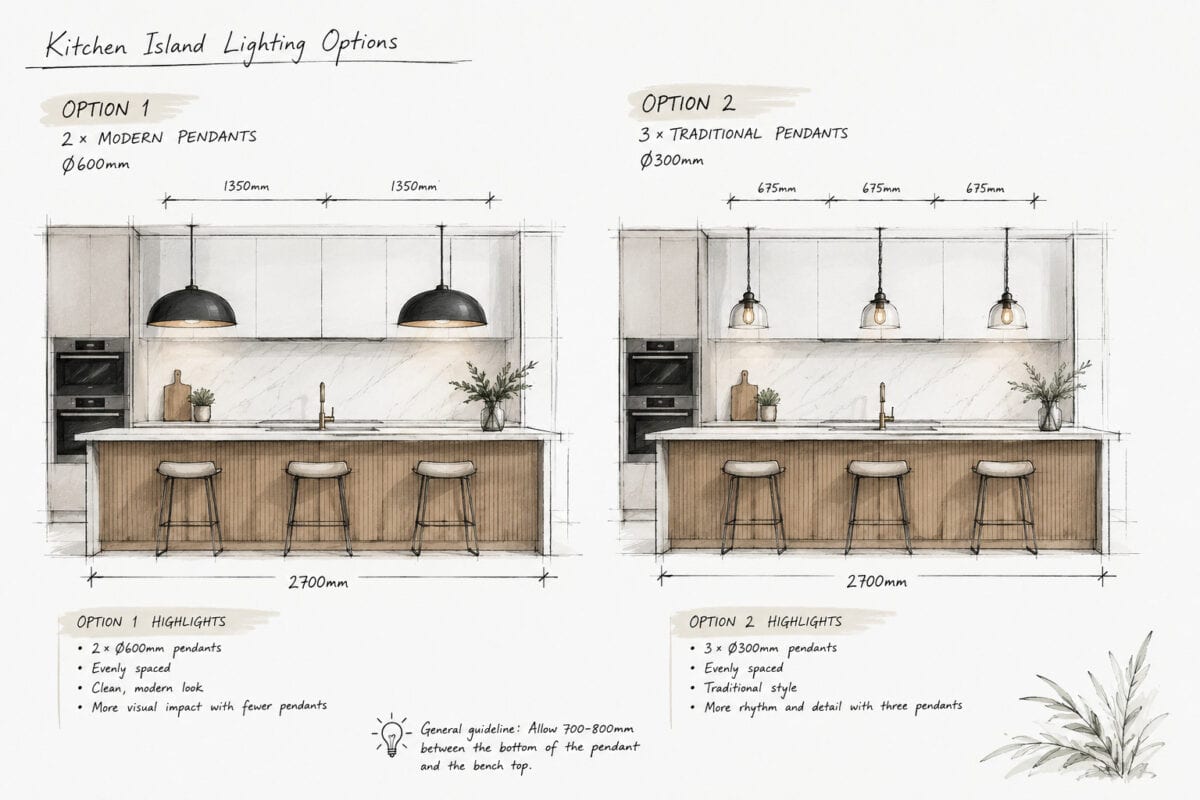
This is the part people skip, and then wonder why their kitchen island lighting looks off. Sizing and placement isn’t glamorous, but it’s honestly the difference between a kitchen that looks professionally done and one that looks like a DIY guess.
Modern spacing rules tend to favor even, calculated gaps between fixtures. For pendants over an island, the general guideline is spacing them 24 to 30 inches apart, center to center. If you’ve got a long linear island, sometimes it’s just one continuous fixture instead of separate pendants, which sidesteps the spacing question entirely. I like that option for anyone who overthinks symmetry, myself included.
Traditional height standards are pretty consistent across most kitchens. Pendants should hang 30 to 36 inches above the counter surface, and chandeliers over a table usually sit a bit higher, around 30 to 34 inches above the tabletop. There’s some wiggle room if you’ve got higher ceilings, add about 3 inches of height for every additional foot of ceiling above the standard 8 feet.
Island size matters way more than people realize when picking fixture count. A general rule I use, islands under 6 feet usually only need two pendants, anything 6 to 8 feet does well with three, and islands over 8 feet can handle a linear fixture or four smaller pendants. Going too small on fixtures over a big island makes the whole thing look under-lit and kind of sad, honestly.
Multiple light arrangements need some breathing room to feel intentional instead of cluttered. A decent rule of thumb, add up the length and width of the room in feet, and that number in inches gives you a rough total fixture diameter to aim for. So a 12×14 room would be looking at around 26 inches total, which might mean two 13-inch pendants instead of three smaller ones.
General guidance: pendant diameter should be about one-third to one-half the width of your sink or stove area below it if it’s centred there. Get a tape measure before you fall in love with a fixture online; trust me on that one.
Lighting Technology and Features
When comparing modern vs traditional kitchen designs, lighting technology is one of the biggest differences you’ll notice once you look beyond the cabinetry and finishes. Traditional kitchen lighting tends to focus on simple switches and classic light fittings, while modern kitchen lighting can incorporate LED technology, smart controls, dimming, adjustable colour temperatures and automated lighting scenes.
I’ve found that the best kitchen lighting isn’t necessarily the one with the most technology. It’s the lighting that works properly for the way the kitchen is actually used.
Smart Lighting Integration
One of the biggest advantages of a modern kitchen design is the ability to integrate smart lighting into the overall home. LED downlights, pendant lights, under-cabinet lighting and even kickboard lighting can be connected to smart switches or a home automation system.
For example, you might have a “Cooking” setting that turns on the main ceiling lights and bright task lighting under the overhead cupboards. In the evening, you could select an “Entertaining” setting that dims the kitchen lighting and leaves the pendant lights over the island providing the main feature.
This doesn’t mean traditional kitchens can’t have smart lighting. They absolutely can.
A Shaker-style kitchen with timber cabinetry, stone benchtops and traditional hardware can still have a very modern lighting control system hidden behind the scenes. That’s something I think is often misunderstood when people compare modern and traditional kitchen styles.
The technology doesn’t have to dictate the appearance of the kitchen.
One mistake I have seen is choosing the beautiful light fittings first and thinking about the controls afterwards. It sounds harmless, but once the electrical wiring and plasterboard are finished, changing the switching arrangement can become an expensive nuisance.
My rule is simple: plan the lighting zones before the electrician starts installing everything.
Dimming Capabilities
Dimmable kitchen lighting is another feature that can make a huge difference to how comfortable a kitchen feels.
Think about how many different jobs happen in the same room. You might need bright lighting while chopping vegetables, softer lighting while eating breakfast and low-level lighting later in the evening when you’re simply walking through to get a glass of water.
A good lighting design should allow for those changes.
Modern LED kitchen lighting generally provides excellent dimming options, but there is an important catch. The LED fitting, driver and dimmer switch need to be compatible with one another.
I’ve learned not to simply ask, “Is this LED light dimmable?” Instead, I want to know whether the complete lighting system will dim smoothly without flickering, buzzing or dropping out at low levels.
This is especially important when you’re using several LED fittings on the same circuit. A system that looks perfect when switched on isn’t necessarily going to behave properly when dimmed.
Traditional kitchens can also benefit enormously from dimmers. You don’t need a contemporary kitchen to justify modern lighting technology.
Colour Temperature Options
Colour temperature is another area where modern LED lighting has given homeowners much more choice.
Lighting colour temperature is measured in Kelvin (K). For residential kitchens, you’ll commonly come across warm white lighting around 2700K–3000K, with cooler options around 3500K–4000K creating a cleaner, brighter appearance.
There isn’t one colour temperature that is automatically correct for every kitchen.
A traditional kitchen with timber cabinetry, cream cupboards, natural stone and brass or bronze hardware will often look beautiful with warmer 2700K–3000K lighting. The warmer light helps reinforce that comfortable, classic feeling.
On the other hand, a contemporary kitchen with white cabinetry, polished surfaces and cooler grey tones may suit a slightly cleaner colour temperature.
One thing I learned fairly quickly is to avoid mixing colour temperatures randomly. I’ve walked into kitchens where one downlight looked warm, another looked almost blue and the pendant lighting was somewhere in between.
It sounds like a minor detail, but your eyes notice it straight away.
If you’re planning a new kitchen, try to keep the colour temperature consistent across the main lighting layers, unless there is a deliberate design reason for doing otherwise.
Energy Efficiency Comparison
When it comes to energy-efficient kitchen lighting, modern LED technology has a significant advantage over older incandescent and halogen lighting.
A traditional 50-watt halogen downlight, for example, can often be replaced by an LED fitting using considerably less electricity while providing suitable light output. If you have ten or fifteen downlights operating regularly, the energy difference can add up.
LED lights also generally have a much longer rated lifespan than traditional incandescent lamps and produce considerably less heat.
That’s useful in a kitchen because you’re already dealing with heat from ovens, cooktops, kettles and other appliances.
However, I wouldn’t choose LED lighting based on energy efficiency alone.
I’ve seen cheap LED fittings that technically use very little electricity but produce unpleasant light, have poor colour rendering or don’t last as long as expected. Good kitchen lighting needs to balance energy efficiency, light quality, colour rendering and longevity.
Saving electricity is great, but if your expensive new kitchen looks like a supermarket aisle, something has gone wrong.
Control System Differences
The final difference between modern and traditional kitchen lighting is often the lighting control system.
A traditional kitchen may have a straightforward arrangement with one switch for the main ceiling lights, another for the pendant lights and perhaps another for under-cabinet lighting. There’s nothing wrong with this approach. It’s simple, familiar and easy for everyone in the house to understand.
Modern kitchen lighting can be divided into several independent lighting zones and controlled using dimmer switches, smart switches, sensors, timers or home automation systems.
For example, I might separate a kitchen into:
- General ambient lighting
- Task lighting over preparation areas
- Pendant lighting over the island
- Under-cabinet lighting
- Feature lighting
- Low-level night lighting
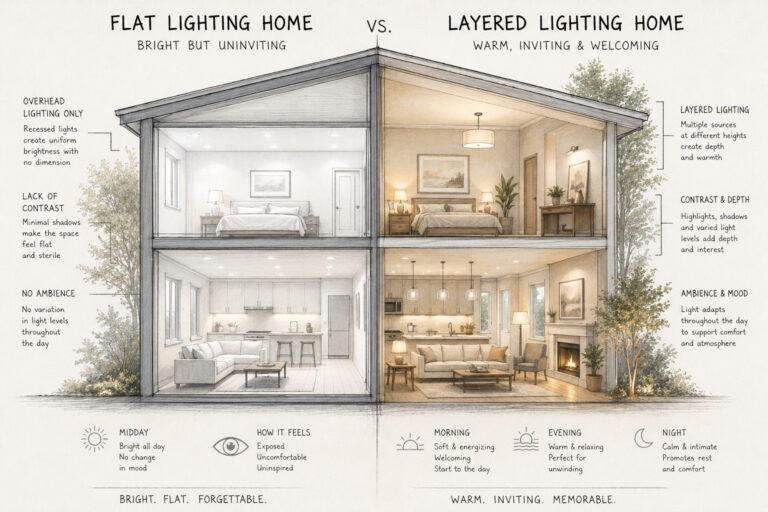
Each layer can then have its own control, allowing the kitchen to change depending on what is happening in the room.
But here’s where I think people can get carried away.
Don’t add technology simply because it exists.
A complicated smart-home system isn’t automatically better than three well-positioned switches and a couple of good dimmers. If someone needs to open an app on their phone just to turn on the kitchen lights, I’m not convinced we’ve improved anything!
The best approach is to start with the lighting design, not the technology. Work out where light is needed, what each area of the kitchen is used for and how you want the room to feel at different times of the day.
Then choose the control system that supports those needs.
Whether you’re designing a sleek modern kitchen or a warm traditional kitchen, the fundamentals remain the same: good task lighting, comfortable ambient lighting, useful controls and lighting that suits the materials and colours in the room.
Modern technology simply gives us more ways to achieve those things.
And that is probably the biggest lesson I’ve learned about kitchen lighting. More technology doesn’t automatically mean better design. When the lighting has been properly planned, the technology should almost disappear into the background — you simply notice that the kitchen feels good, works well and is easy to live in.


So,I like it